
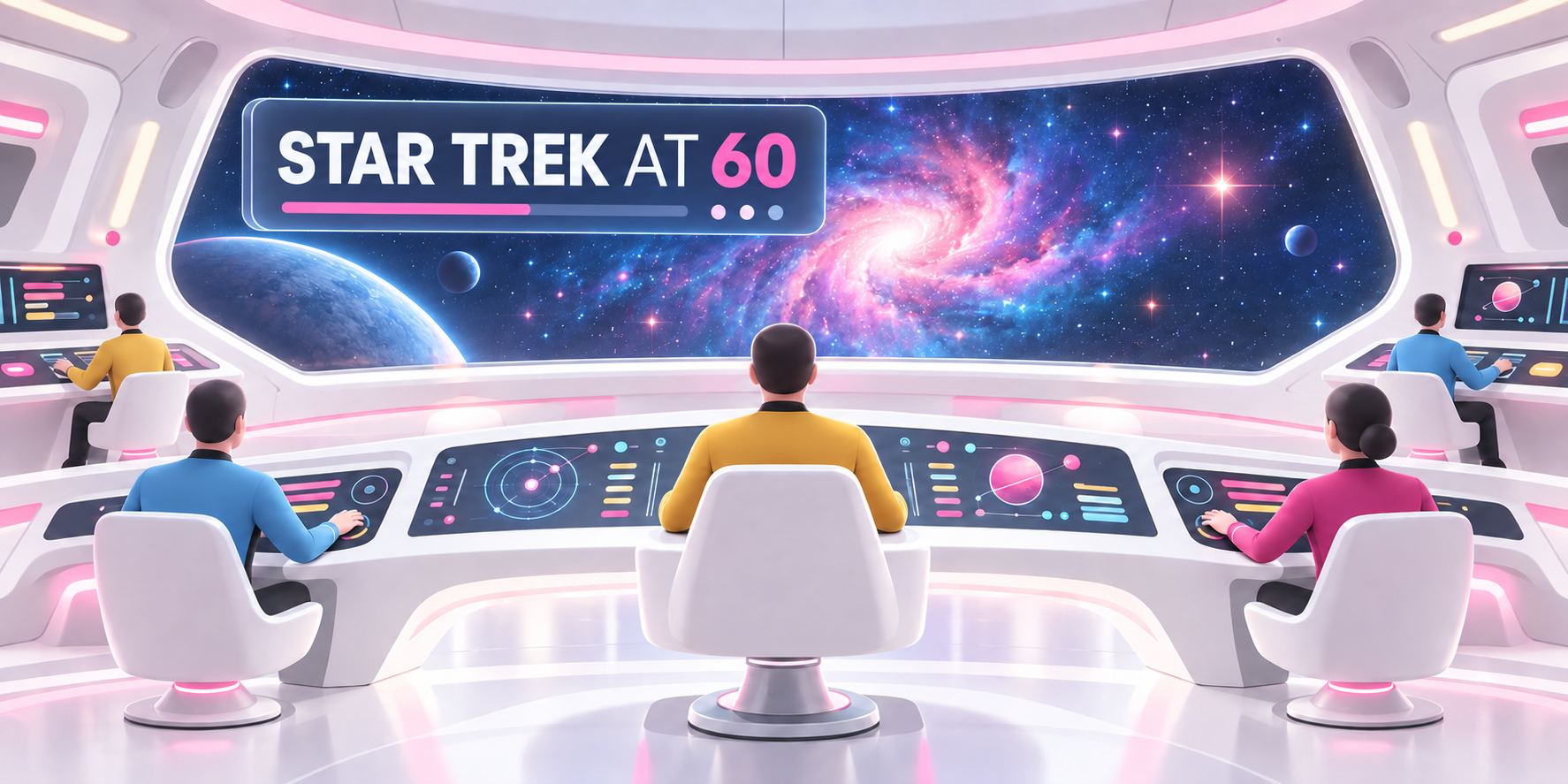
Happy 60th Birthday, Star Trek
On 8th September 1966, television viewers in the United States first boarded the USS Enterprise. Sixty years later, Star Trek remains one of the most recognisable and enduring ideas in popular culture.
It began with painted backdrops, chunky switches and wonderfully optimistic ideas about where science and technology might take us. Since then, it has grown into films, series, books, games, conventions and a huge worldwide community. More importantly, it has held onto a central belief: the future is something people can build together.
Imagining technology, then inspiring it
Star Trek has always had a fascinating relationship with real-world science and technology. It imagined handheld communicators, video calls, voice-controlled computers, tablets, automatic doors and medical scanning long before many of those things became familiar parts of everyday life.
That does not mean the programme invented every modern gadget. Its real influence was in making ideas feel useful, natural and human. The technology on the Enterprise was not presented as a novelty. It was simply part of how a capable team communicated, learned and got on with the job.
In turn, the programme has consistently looked at the most exciting scientific and technical developments of its era and asked a bigger question: where could this lead? That approach has helped Star Trek stay relevant. It has used current ideas in computing, space exploration, robotics and communication as a starting point, then explored their potential consequences with imagination.
Sometimes the predictions have been surprisingly close. Sometimes they remain firmly in the science-fiction column. We are still waiting for the transporter, which would make visiting customers across the UK rather more convenient.
A visual language built for the future
The influence is not just in the gadgets. Star Trek has always been remarkably good at making the future look organised, understandable and inviting.
From the original series onwards, its sets and interfaces have used clear colour coding, purposeful shapes, bold symbols and layouts designed to be read quickly. Buttons look like buttons. Displays place important information where people would expect to find it. Even when the technology is fictional, the design often makes sense at a glance.
Those principles have travelled well. The clean lines, strong contrast, panels, status indicators and colour-led information used throughout the franchise naturally lend themselves to digital design. Over the years, Star Trek-inspired interfaces and visual styles have influenced web design, app design, dashboards and the wider world of user experience.
There is a reason so many “futuristic” websites borrow the look of a starship control panel. The best examples do not just look impressive. They make information feel clear, ordered and useful.
Good design helps people get things done
That is perhaps the most useful lesson for web design. A website does not need to look like the bridge of the Enterprise to benefit from the same thinking.
Good design helps people understand where they are, what they can do next and how to find what they need. It uses colour, spacing, type, labels and familiar patterns to reduce effort. The aim is not to make visitors stop and admire the interface. It is to help them complete a task confidently.
For a small business website, that might mean making contact details easy to spot, creating a straightforward enquiry form, or ensuring services are explained in plain English. In Star Trek terms, the screen should tell you what matters without requiring a Starfleet Academy course first.
A future worth looking forward to
Star Trek has never been naïve about technology. Its best stories recognise that new tools can create new problems, and that people still need to make thoughtful choices about how they use them. That feels particularly relevant as artificial intelligence, automation and digital services continue to develop quickly.
Yet it has always offered a positive alternative to the usual doom-and-gloom vision of the future. It imagines curiosity, inclusion and exploration as strengths, with technology there to support people rather than replace them.
So, happy 60th birthday, Star Trek. Thank you for six decades of memorable characters, ambitious ideas, brilliant design and a future that still feels worth working towards.
Live long and prosper.
Star Trek Day is held on 8th September to mark the original series’ premiere in 1966. Read more about the official 60th anniversary celebrations.