
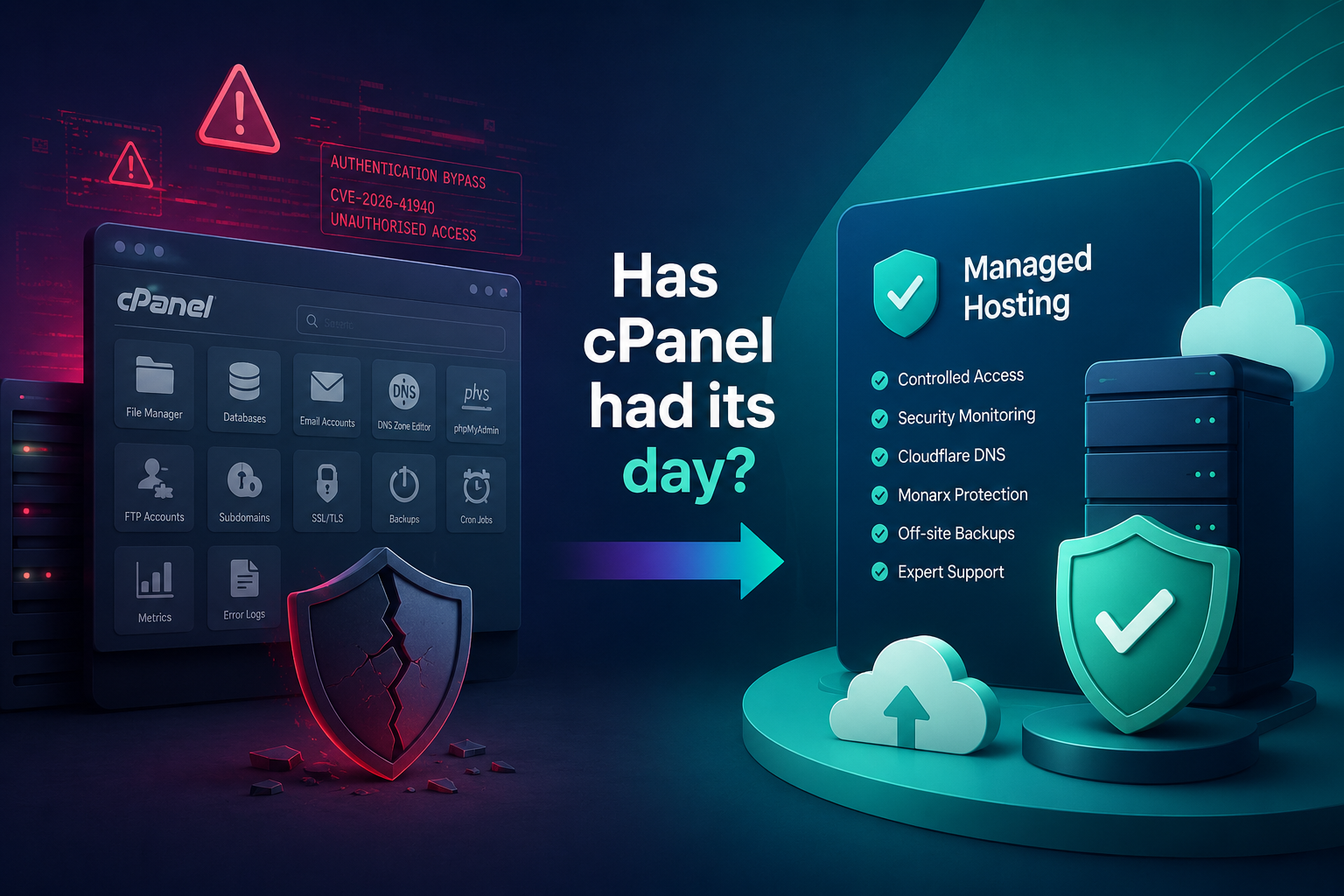
Has cPanel Had Its Day? Why Website Hosting Needs a Rethink
We should start with a clear reassurance: O’Brien Media does not use cPanel for customer hosting.
That matters because cPanel has been in the news recently for some fairly serious security reasons. For many years, cPanel has been one of the most recognisable names in website hosting. For lots of people, it is simply “the hosting control panel”. It gives customers access to email accounts, files, databases, DNS settings, backups, redirects, domains, subdomains and a long list of other hosting tools.
That has always been its big selling point. It gives people lots of control.
But that is also part of the problem.
Recent security issues affecting cPanel and WHM have raised a fair question: has cPanel had its day, at least for the kind of hosting most small businesses actually need?
Why cPanel is back in the spotlight
This is not about saying every cPanel host is unsafe. cPanel is widely used, mature software and many hosting companies manage it carefully. The issue is that when a platform becomes such a large and powerful gateway into hosting servers, any serious vulnerability can become a very serious problem very quickly.
In April 2026, cPanel published a security update for CVE-2026-41940, an issue affecting cPanel & WHM and WP Squared. The National Vulnerability Database described it as an authentication bypass vulnerability in the login flow, which could allow unauthenticated remote attackers to gain unauthorised access to the control panel.
That is the kind of sentence that sounds technical, but the plain-English version is much simpler: someone who should not be able to get in may be able to get in without logging in properly.
Security researchers and industry reports also warned that the issue was being exploited. Cybersecurity Dive reported widespread exploitation of CVE-2026-41940 in early May 2026, while the UK’s NHS Digital issued a cyber alert warning that the vulnerability could allow unauthorised access to the affected cPanel management console.
And this was not the only recent cPanel security issue. cPanel also published a May 2026 update for CVE-2026-29201, which involved an arbitrary file read issue where insufficient validation could cause a file to be made world-readable.
Again, that sounds technical. In practical terms, these are the types of issues that make hosting providers move quickly, apply patches, review logs and reassure customers.
But they also highlight something bigger.
The problem with giving everyone too much access
A traditional hosting control panel gives a lot of access to a lot of things. That can be useful for developers and technical users, but most small business website owners do not need that level of access day to day.
They do not usually need to edit DNS zones, browse raw server files, change PHP settings, manage SSL systems, alter databases or create advanced mail routing rules.
They usually need their website to work, load quickly, stay secure, be backed up properly and have someone reliable to contact when they need help.
That is why O’Brien Media does things differently.
How O’Brien Media handles hosting
We do not use cPanel for our hosting customers. Instead, we use a more managed approach built around the things that most customers actually need.
The everyday hosting tasks are handled by our own internal tools and by our team, rather than giving every customer access to a large, general-purpose control panel with far more features than they are ever likely to use.
That does not mean customers lose support. It means they gain a safer, more guided service.
If a customer needs help with hosting, DNS, email, SSL, backups or website changes, they can speak to us. We know the customer, we know the website, and we know the hosting environment. We are not expecting a small business owner to log into a control panel and figure out which button might break their website.
That matters because security is not just about software. It is also about reducing unnecessary access.
The more tools, buttons, plugins, panels and permissions you expose, the more there is to secure. A stripped-back, managed approach means customers are not being handed access to powerful server-level features they do not need. It also means we can be more deliberate about who gets access to what.
We only host customers we know
At O’Brien Media, we only permit access to our hosting servers for customers we know, either because we have carried out work for them or because we provide ongoing support.
We are not running a wide-open, anonymous hosting platform where anyone can sign up, upload files and start using server resources.
That is an important distinction.
Many mass-market hosting platforms are built around scale. They need to let thousands of customers self-serve. cPanel fits that model well because it gives lots of people a way to manage lots of hosting features themselves.
Our model is different. We provide managed website hosting and support for businesses we work with directly. That allows us to keep things tighter, more controlled and more personal.
Extra protection around the hosting environment
We also add security layers around the hosting itself.
We use Monarx security software to help detect and prevent attempted hacks, malware and malicious activity. Monarx describes its platform as AI-powered protection for web hosts, with coverage for common web technologies including PHP, Node.js, Python, Ruby, Perl and Java.
We also use Cloudflare DNS, adding another layer of resilience and protection around domain management. Cloudflare’s DNS documentation describes its DNS service as fast, resilient and designed to help protect against issues such as DDoS attacks, route leaks and hijacking.
Backups are another key part of the picture. We take two sets of off-server, off-site backups for disaster recovery. That means backups are not just sitting on the same server as the website. If something serious happens to a hosting server, there is a route back.
No hosting setup is completely risk-free
No hosting provider can honestly claim to be completely risk-free. Anyone who says otherwise is probably overselling it.
Websites, servers, plugins, themes, DNS, email and software all need ongoing care. Security is not a one-time job. It is a process of maintenance, monitoring, sensible access control and quick action when something needs attention.
But there is a big difference between giving every customer a large control panel packed with features they may not understand, and providing a managed hosting environment where the right people handle the right tasks.
So, has cPanel had its day?
For some users, probably not. Developers, agencies and technical teams who genuinely need full control may still prefer cPanel or similar tools. In the right hands, properly maintained, it can still be useful.
But for many small businesses, the question is not really “which control panel do I get?”
The better question is: who is actually looking after my website?
Because most business owners do not want a dashboard full of server tools. They want confidence. They want to know their website is being monitored, protected, backed up and supported by people who understand it.
That is where managed hosting comes into its own.
At O’Brien Media, our approach is deliberately less complicated. We do not give customers cPanel because, in most cases, they do not need cPanel. They need secure hosting, reliable support, sensible backups, careful access control and a team they can speak to when something needs doing.
Recent cPanel security issues are a useful reminder that convenience and control are not always the same as safety.
Sometimes, the safer option is not giving everyone more buttons.
Sometimes, it is making sure the right people are looking after the right things.