Should My Business Have a Second Website? The Case for an Informational Resource Site
Should Your Business Have a Second Website?
Most businesses have one website. It does the job — it tells people who you are, what you do, and how to get in touch. But there’s a strategy that’s quietly gaining traction among forward-thinking businesses, and it’s one we think more of our clients should know about: building a second, separate website dedicated entirely to answering questions about your industry.
It might sound like extra effort. And yes, it does require some investment upfront. But done properly, it can become one of the most valuable long-term digital assets your business has — and the benefits stretch well beyond just getting a bit more traffic.
What Do We Mean by a Second Website?
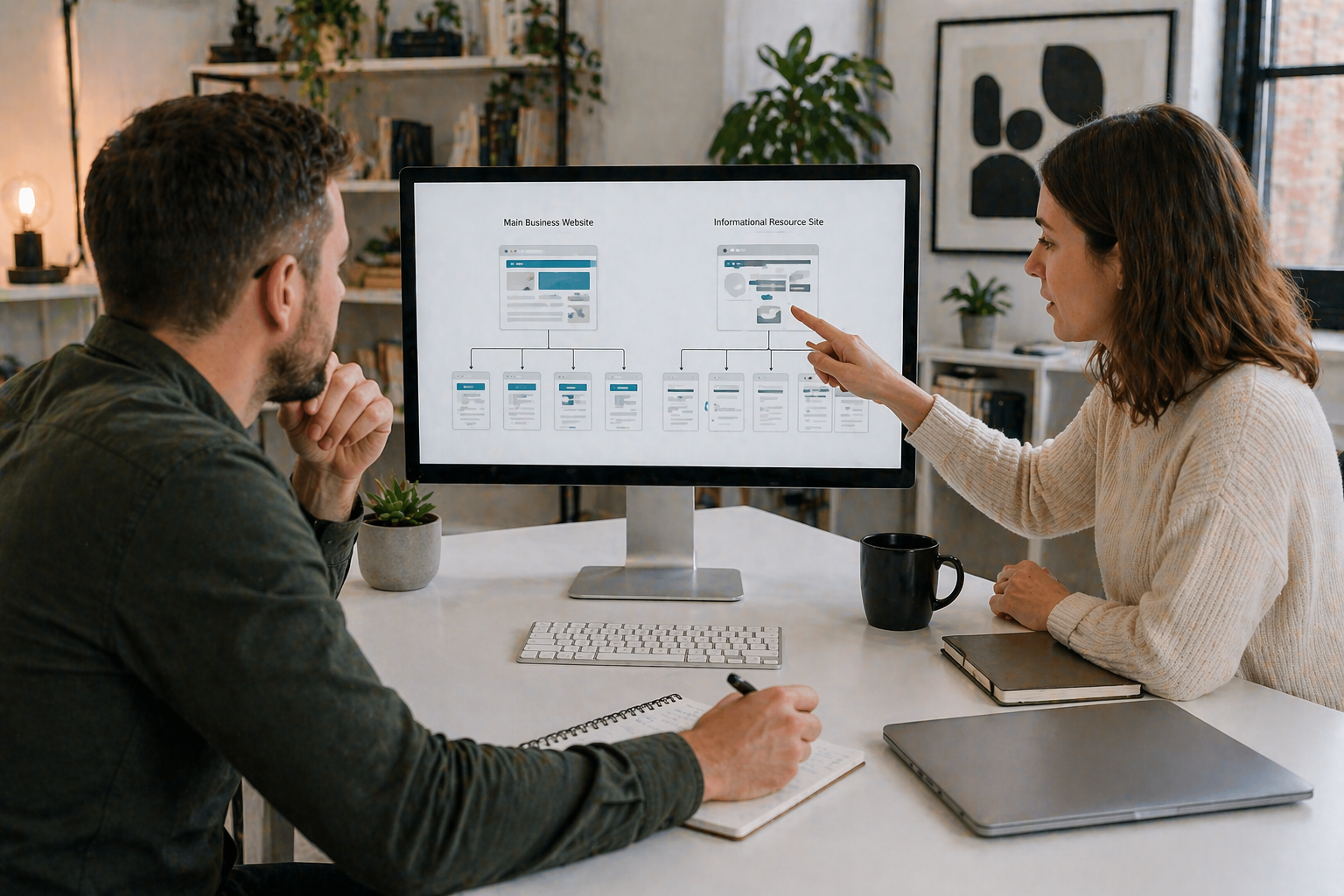
An informational resource site is a standalone website — separate from your main business site — that’s built around answering the kinds of questions your potential customers are already searching for online. Rather than selling, it educates.
If you run a plumbing business, your main site talks about your services and service area. A resource site might answer questions like “Why is my boiler losing pressure?”, “What’s the difference between a combi and a system boiler?”, or “How much does it cost to move a radiator?” These are questions people type into Google every day. If your site answers them clearly and helpfully, those people find you — before they’ve even started thinking about who to call.
The site doesn’t need to be huge. A focused collection of genuinely useful articles and guides will outperform a sprawling site full of thin content every time.
The SEO Argument
Search engines reward websites that demonstrate real expertise and authority in a subject area. The challenge with a typical commercial website is that it’s primarily set up to convert — it has service pages, pricing, and calls to action. That’s exactly what it should do. But it can make it harder to rank for the broader, informational queries that pull people in at the start of their decision-making journey.
A dedicated resource site changes that. Because its whole purpose is to inform rather than sell, it can go deep on topics in a way that would feel out of place on a commercial site. Over time, as it builds up a library of well-written, useful content, it starts to develop what’s known as topical authority — the signal to Google that this is a credible, comprehensive source of information on a given subject. Rankings tend to follow.
Most businesses have one website. The ones thinking ahead have two. Share on XThere’s also a practical benefit when it comes to links. A site that genuinely helps people tends to attract links naturally, from other websites referencing useful content. Those links are a significant ranking signal, and they’re far more valuable than anything manufactured.
Why This Matters Even More Now That AI Is in the Picture
Here’s where the strategy becomes particularly relevant in 2025 and beyond. The way people find information is changing. Alongside traditional search, huge numbers of people are now turning to AI tools — things like ChatGPT, Google’s AI Overviews, Microsoft Copilot, and others — to get answers to their questions.
These AI systems don’t work like a search engine. They’ve been trained on vast amounts of content from across the web, and they surface information based on what’s credible, well-explained, and widely referenced. When someone asks an AI assistant a question relevant to your industry, the AI draws on sources it considers trustworthy and authoritative.
We’ve written before on this blog about making your website AI-friendly, and the same principle applies here. A resource website that consistently publishes clear, accurate, well-structured information is far more likely to be referenced in AI-generated answers — either because it’s been indexed and used as a source, or because it contributes to the broader web of authoritative content that AI systems learn from. In industry circles, this is sometimes referred to as “LLM visibility” or simply getting your business mentioned in AI responses.
If you want your business to be the answer someone receives when they ask an AI tool a question relevant to your services, a body of credible, genuinely helpful content is one of the most effective things you can build.
You Build Trust Before the Sales Conversation Even Starts
There’s a benefit here that’s easy to overlook when you’re focused on the technical side of things. When a potential customer finds your resource site, reads a thorough and honest answer to a question they had, and then realises the site is connected to your business — something important happens. Trust is built before any sales conversation takes place.
They’ve already experienced you as helpful. They’ve seen that you know your subject. By the time they reach out, they’re not starting from scratch — they’re starting from a position of confidence in you.
Your main website sells. But what if you had a second one that educates? Share on XFor service businesses in particular, where clients are often making a decision that involves some degree of trust or risk, that head start can make a real difference to your conversion rate.
What Makes a Resource Site Worth Having?
The most effective resource websites share a few things in common. They’re genuinely useful — written for real people with real questions, not for search engines. They’re well organised, so visitors can find what they need and naturally discover related content. They’re updated regularly, because fresh content signals to search engines that the site is active and relevant. And they’re honest, even when the honest answer is nuanced.
The biggest trap with any content-driven site is chasing volume at the expense of quality. Twenty well-written, genuinely helpful articles will outperform two hundred thin, repetitive pages — in rankings, in AI visibility, and in the impression they leave on visitors.
Is It the Right Move for Your Business?
A second website isn’t right for every business at every stage. It takes a commitment to producing consistent content over time, and the results tend to build gradually rather than appearing overnight. This is a long-term play, not a quick win.
But for businesses with a clear area of expertise and the patience to build something properly, it can become an enormously valuable asset. It works in the background while you’re busy with clients. It builds authority that compounds over time. And increasingly, it’s the kind of presence that puts your business into the conversation when AI tools are helping people decide who to call, who to trust, and who to hire.
If you’d like to talk through whether a resource website could work for your business, we’d love to have that conversation. Give us a call on 01793 239239 or drop us an email at [email protected] and we’ll give you an honest steer on what’s involved.